

Anatomy of a Smear Campaign: How the 1776 Forged Letters Targeted George Washington
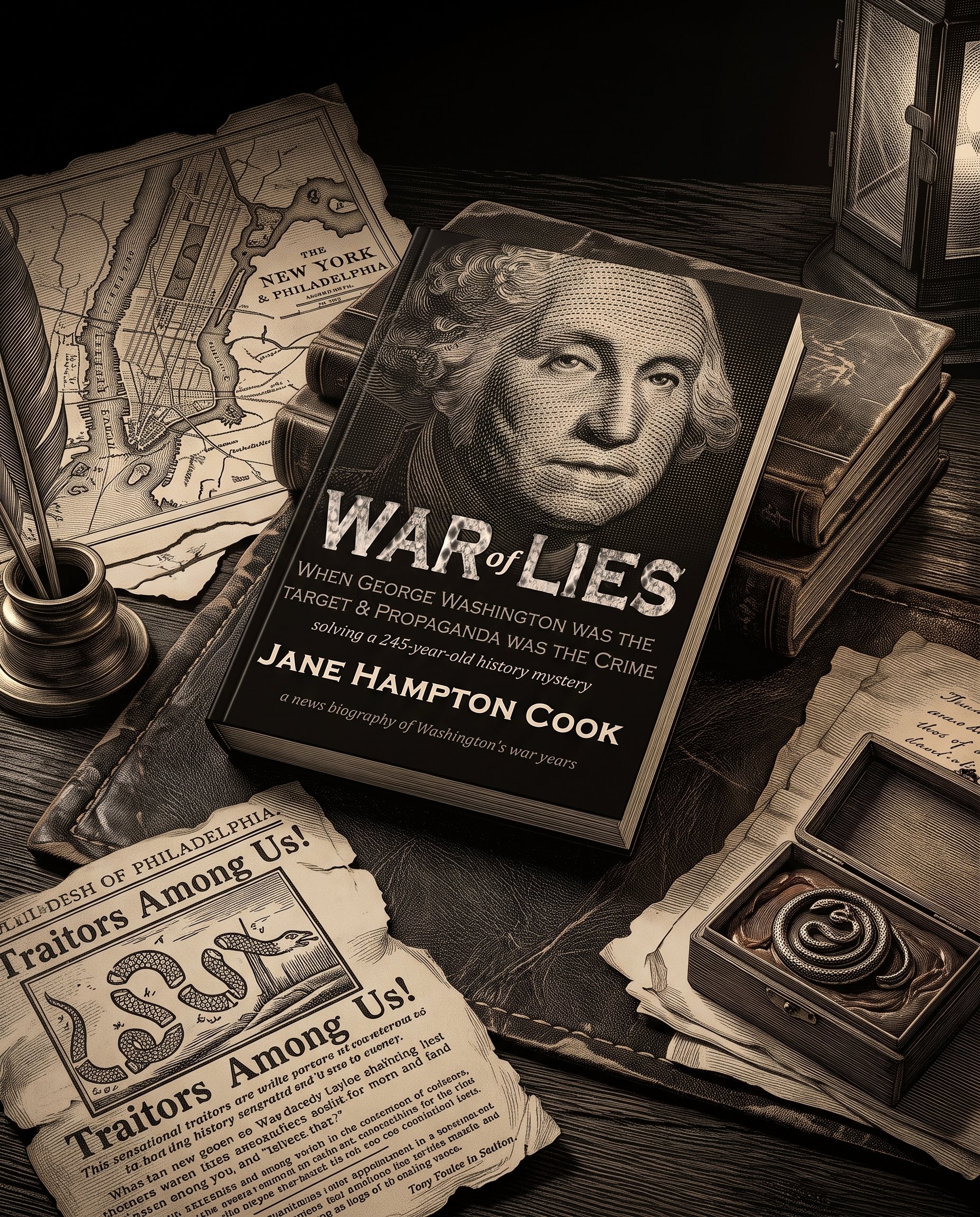
War of Lies: When George Washington Was the Target and the Propaganda Was the Crime by Jane Hampton Cook
Introduction
How can a lie about a leader sound so intimate that strangers begin to repeat it as truth?
In February 1778, George Washington was at Valley Forge, trying to preserve and train an ill-clad Continental Army while British forces occupied Philadelphia. Then a different weapon arrived: a handbill and newspaper reports claiming to print his private letters to Martha Washington, Lund Washington, and Jackie Custis.
The alleged correspondence did not merely criticize a battlefield decision. It portrayed Washington as a man who distrusted Martha, feared death with “infamy and disgrace,” opposed independence, and cared more for reputation than principle. The counterfeiters aimed at the inner man because a personal lie can do what a military setback cannot: make people question the character behind the command.
The forged letters reveal an old disinformation playbook. Plausibility came first. Then came emotional pressure, private details, and accusations designed to turn Washington’s virtues—prudence, concern for honor, and sober awareness of risk—into evidence of cowardice and hypocrisy. The same mechanics still deserve a careful audit before a rumor, a headline, or a hostile narrative recruit us into somebody else’s war of lies.
The Power of the Plausible Lie
A smear campaign rarely begins with a ridiculous claim. It begins with facts that can be checked, then fastens fiction to them. The counterfeit letters used real people from Washington’s household: Martha Washington, Lund Washington, Jackie Custis, and Billy, Washington’s servant. Those names were the counterfeit seal on a false document.
The preface to the forged pamphlet supplied an elaborate chain of custody. It claimed that a soldier serving under Oliver De Lancey encountered Billy among the prisoners at Fort Lee and received a small portmanteau belonging to Washington. Inside, the writer claimed, were an almanac, a diary, letters from Washington’s family, and rough copies of Washington’s replies.
This detail mattered. Keeping copies of letters in a letter book was a common practice, so the story did not sound impossible. The counterfeiters used a real evacuation, a real place, a real servant, and a believable record-keeping habit to make readers lower their guard. That is how a half-truth operates: it borrows the credibility of what is true and spends it on what is false.
Use a five-minute plausibility audit when a damaging story arrives in your email inbox or your social media feed. Write the claim at the top of a page, then divide the page into three parts: “Verifiable facts,” “Unverified bridge,” and “Damaging conclusion.” The bridge is often where the deception hides: a real meeting becomes a secret plot, a real document becomes a confession, or a real relationship becomes evidence of betrayal.
Apply the audit to the Fort Lee story. Fort Lee fell to the British in November 1776. Billy was a real member of Washington’s household. A portmanteau was a real small trunk. But the key assertions—that Billy had been captured, that Washington’s papers had fallen into enemy hands, and that the contents were authentic—required proof. The tale offered atmosphere instead of evidence.
This distinction is essential when a report feels too detailed to be false. Details can establish truth, but they can also be stage props. Ask: Which facts can I independently confirm? Who had firsthand access? What document, witness, or date verifies the leap from fact to accusation? Do not let a vivid backstory substitute for a chain of evidence.
The common obstacle is the pressure to react before others do. Yet repeating an accusation while “just asking” about it still gives the accusation another set of legs. Rule 79 from George Washington’s favorite social guidance book, The 110 Rules of Civility, gives the better discipline: “Be not apt to relate news if you know not the truth thereof.” Pause long enough to identify whether you are looking at evidence—or merely a well-written trap.
Weaponizing Insecurities
Once the forged letters gained plausibility, they turned toward Washington’s relationships and inner fears. The false letter to Martha suggested that he questioned her “prudence” and “fidelity.” Another counterfeit letter to Lund Washington claimed that the Commander-in-Chief felt himself “a very coward.”
The attack was calculated. Washington’s public authority rested not only on rank, but also on the confidence of soldiers, Congress, friends, and family. If the public could be persuaded that he distrusted Martha, privately opposed independence, or secretly judged the cause hopeless, then every order he issued could be recast as an act performed by a hypocrite.
One forged passage exposed the counterfeiter’s strategy: “I am not afraid to die, why should I? I am afraid only to die with infamy and disgrace.” The sentence sounds psychologically shrewd because it twists a recognizable concern—honor—into vanity. Washington had acknowledged the risk to his reputation when he accepted command in 1775, but he had also stated what he could offer the cause: “a firm belief of the justice of our cause—close attention in the prosecution of it—and the strictest integrity.”
This is projection at work. A propagandist does not need to invent a trait that is wholly foreign to the target. The more effective tactic is to seize a genuine strength, remove it from context, and give it a sinister motive. Prudence becomes cowardice. A concern for honor becomes hunger for applause. A private reservation becomes proof of public disloyalty.
For example, a leader’s careful review of a proposal may be framed as indecision. The answer is not a frantic denial of every motive assigned by critics. Preserve the timeline, the original communications, the stated decision criteria, and the people who can accurately describe the process. Facts gathered before a crisis are easier to communicate than facts hunted after the rumor mill begins.
Washington recognized the letters as forgeries at once, but recognition did not make the attack painless. He called their “villainy” and “artifice” difficult to measure, and he privately warned that the enemy was forging letters to make him appear hostile to the measures of the continent. Public lies impose a psychological burden because the target must continue carrying real responsibilities while others debate an invented identity.
The remedy is not merely emotional toughness. It is disciplined preparation: know your record, preserve your evidence, tell trusted allies the truth, and refuse to let an opponent define the terms of your character. A reputation cannot prevent every lie, but it can make the lie harder to sustain when the facts are examined.
Conclusion
The forged letters of 1777 and 1778 were not random insults tossed into the wind. Their author mixed real names, recognizable events, domestic details, and believable practices with fabricated claims about Washington’s marriage, motives, courage, and commitment to independence. The aim was to make a counterfeit character appear more credible than the real one.
Jane Hampton Cook’s book, War of Lies: When George Washington Was the Target and Propaganda Was the Crime follows is a true crime who done it, a “history mystery” revealing four suspects behind the forgery campaign and the pattern of evidence that points to one of them as the culprit. George Washington never knew the culprit’s identity but thanks to the literary record they left behind, one suspect stands above the rest.