

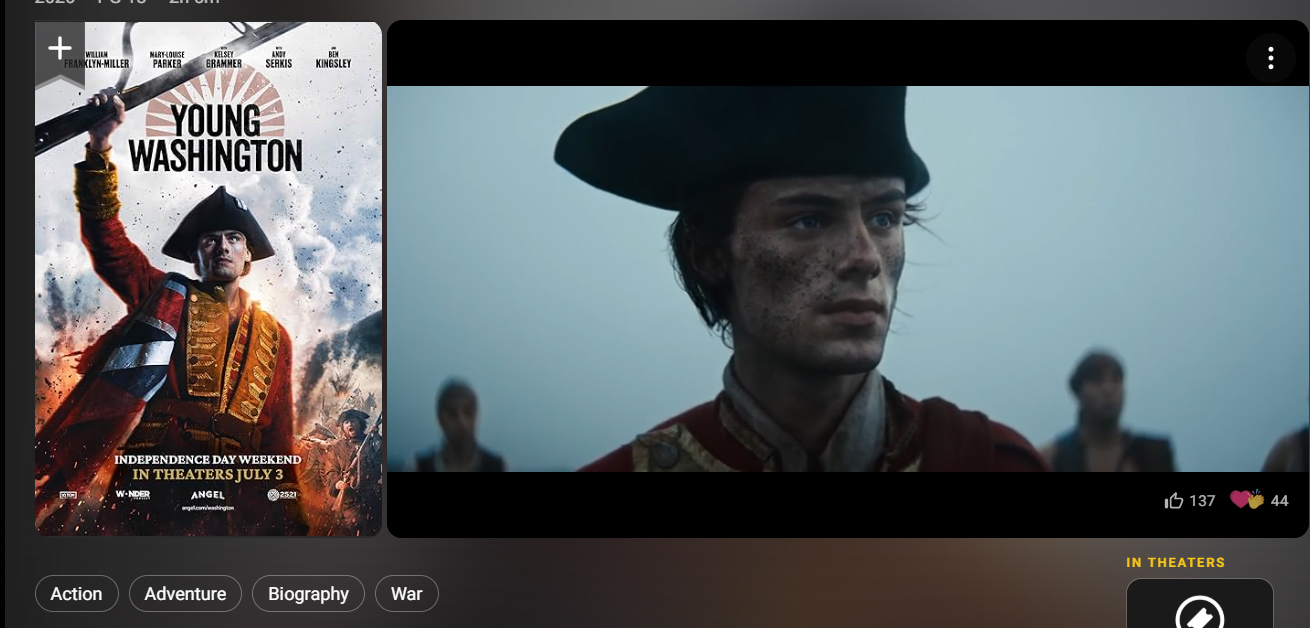

For the past few months, I’ve seen ads for YOUNG WASHINGTON, a new movie from Jon Erwin and Angel Studios that focuses on George Washington’s origins as a young soldier in the French and Indian War in the 1750s. Because I’ve written about this phase of Washington’s life in at least four of my books, I have been dying to see this film. Then, several friends and colleagues saw screenings of the film before its release and loved it. I found my self feeling a bit jealous that I didn’t get to preview it with them.

But hooray and huzzah! I saw the film on the first day it was in theaters and loved it. Among the story’s many action points, Young Washington portrays a seminal moment in Washington’s life in the midst of great danger.
I first discovered Washington’s near-death miracle nearly 20 years ago when I wrote my first book about the American Revolution called Stories of Faith and Courage from the Revolutionary War. Researching original sources, such as letters, for this book changed my perspective and inspired me to write many more books about the American Revolution and the War of 1812.
Before I began writing my Rev War devotional book for AMG Publishers, I had wondered if Washington was over-rated. After discovering his experiences in the French and Indian War and Revolution, I was humbled and realized why he became a great leader. As Young Washington effectively captures, George learned to put the soldiers in his care above personal glory or ambition. This approach proved essential for winning the Revolutionary War.

One of the most seminal moments in Washington’s life took place on July 9, 1755, when he had four bullets fly through his coat and two horses shot under him in a battle but was unhurt. Word of this miracle spread throughout Virginia. A month later in August 1755, a minister accurately predicted, perhaps even prophesized, that young Washington’s life had been spared for future important service to his nation. This was two decades before the Revolutionary War began.
Fifteen years later in 1770, a native chief, who’d fought against him and had witnessed the 1755 miracle, told Washington that the Great Spirit had protected him that day and he would be the chief of a great nation. Indeed.
As soon as Washington arrived at Fort Cumberland, Maryland, nine days after the 1755 battle, he discovered that his name was on the killed-in-action list that was on its way to Virginia. Even worse, his family would soon be told that he had died, when he hadn’t. Too weak to travel immediately back to Virginia, Washington responded by writing his brother and mother letters to assure them that he was alive. He attributed his miraculous survival in the land of the living to Providence, which protected him beyond all human expectation. Providence in the 1770s meant God’s presence. Because we can now search his digitized writings by keyword, we now know that Washington wrote the name Providence in his letters more than 560 times.
Young Washington captures Washington’s essence and the spirit of his experience and character. The movie uses one of my favorite screenwriting and book-writing techniques to grab the viewer’s attention by starting the story in medias res, which means in the midst of the action. Young Washington begins with Washington on that battlefield on July 9, 1755, in what is now Pittsburgh.
The film then flashes back to the day his father was buried. Washington was only 11 years old when his father died. His half-brother Lawrence Washington, who was 14 years older, steps in and becomes George’s father-figure.
The movie unfolds by unraveling different story threads that culminate in Washington’s realization that he needs to prioritize his men’s needs above all else. Just as he did in my favorite historical TV series, House of David, producer and director Jon Erwin effectively combines action, romance, internal struggle and strong acting into a film that is as satisfying as it is inspiring. Because of the battlefield violence, this film is not for young children. The violence, however, is not gratuitous. Director Erwin is an expert at directing action scenes.


If you want to know what is true vs what was invented in the film you can rest assured that most of the events and story beats are true. Sometimes, however, the timing or chronology of these events are out of sequence of when they actually took place. I wrote in depth about Washington’s French and Indian War years in my book, War of Lies. As a result, I am familiar with the basic chronology of when things happened in his early years, such as the death of his brother Lawrence.
In the film, however, Lawrence’s death happens out of sequence. It is revealed in the movie later than it actually took place. My guess is that the filmmakers timed Lawrence’s death when it had the strongest emotional impact on Washington and the viewer. They did this with several events or facts. This is called compositing, which is a common technique that is often necessary to make a story work in a narrative, non-documentary film.
Another type of compositing is combining two characters into one character. I didn’t notice any character compositing. Though some events took place out-of-sequence, the result reveals Washington’s internal and external struggles as his leadership and character are tested. The best films capture a relatable character arc where the main character undergoes a significant transformation.
I appreciate that the filmmakers accurately portrayed the story’s broad strokes and didn’t compromise the overall truth. The average viewer won’t notice the film’s out-of-order chronological timing. It’s a bit like a mystery where a mystery is revealed to the viewer. The truth about Sally Fairfax, for example, lands at a pivotal moment. What happened is more important than precisely when it happened or when Washington found out about it. By prioritizing the viewers’ emotional responses, the film will have a greater, longer-lasting impact.

That’s important right now because Americans suffer from dire historical illiteracy. For example, only 13% of eighth graders are proficient in American history. Movies and videos are the fastest, most emotionally-impactful medium in our culture. We need more films like Young Washington to reverse this lack of knowledge in our culture. John Adams believed that preserving liberty depended on both the moral character and intellectual character of the people. This lack of historical knowledge leaves young Americans debased in their understanding about America’s origins.
Don’t miss Young Washington. This is a FOMO moment, fear of missing out. Watch it on theaters if you can. If you need to wait until it streams, it will be worth the wait. Young Washington will make you proud to be an American and leave you hungering by for more.

